SHRI
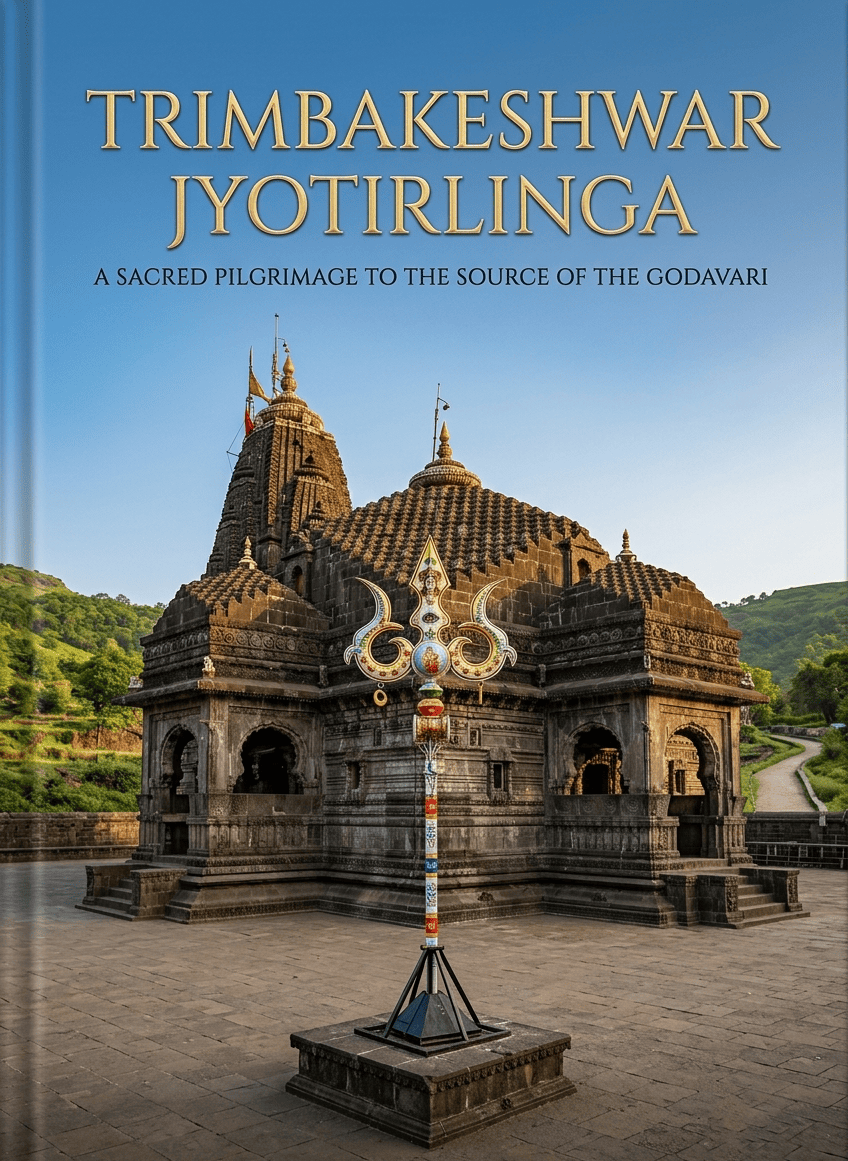
TRYAMBAKESHWAR JYOTIRLINGA
CHAPTER EIGHT
Om Namah
Shivaya
------------------------
INTRODUCTION
"Salutations
to Lord Ganesha. Today, I narrate to you the wonderful story of Tryambakeshwar
– the eighth among the twelve Jyotirlingas."
This is not
merely a story – it is the tale of atonement, the tale of the descent of the
Ganga, and that divine play of Shiva's grace which teaches us – even if a true
seeker becomes tainted by false accusations, he becomes pure again by seeking
refuge in Shiva.
----------------------------
CHAPTER ONE
TRYAMBAKESHWAR
– THE ORIGIN OF THE GANGA OF THE SOUTH
This is a
very ancient tale... when the hills of Maharashtra echoed with the penance of
sages.
Tryambakeshwar
is located in the Nashik district of Maharashtra. It is situated at the foothills
of the Brahmagiri mountain.
This place
is extremely sacred – because this is where the Godavari river originates.
"The
Godavari is called the 'Ganga of the South'. Tryambakeshwar is the origin of
this sacred river."
------------------------
CHAPTER TWO
SAGE GAUTAMA
– THE ASCETIC AND RIGHTEOUS
In ancient
times, Sage Gautama lived in this region. He was extremely righteous, ascetic,
and a devotee of Shiva.
His penance
was so powerful that Indra and other gods began to worry. They felt – "If
Sage Gautama's penance continues to increase like this, our position will be in
danger."
The gods
devised a plan to stop Sage Gautama. They created a deception.
--------------------------
CHAPTER
THREE
THE
DECEPTION OF THE GODS – THE ACCUSATION OF COW KILLING
One day, the
gods left a cow (Kamadhenu) near Sage Gautama's hermitage.
The cow
began grazing around the hermitage. It started eating the grains from the
hermitage.
When Sage
Gautama saw that the cow was eating the grains, he picked up a stick to shoo
the cow away. But... as soon as the stick touched the cow, it died.
"Sage
Gautama was accused of cow killing (gohitya)."
Sage Gautama
became extremely sad and ashamed. He thought – "I am a righteous person,
but I have committed this great sin. Now what will happen to me?"
-------------------------
CHAPTER FOUR
SAGE
GAUTAMA'S ATONEMENT – PENANCE TO SHIVA
Sage Gautama
began intense penance to Lord Shiva to atone for his sin.
He went to
the Brahmagiri mountain and performed severe vows and penance. He kept meditating
upon Shiva for years.
"His
penance was so powerful that fire began to emanate from his body."
Lord Shiva
was pleased with Sage Gautama's penance and appeared before him.
------------------------
CHAPTER FIVE
SHIVA'S BOON
– THE DESCENT OF THE GANGA IN THE SOUTH
Lord Shiva
said to Sage Gautama –
"O
Gautama! I am pleased with your penance. Ask for a boon."
Sage Gautama
said –
"O
Lord! I have been accused of cow killing. Please purify me."
Shiva said –
"O
Gautama! I command the Ganga to descend in the South. She will flow here, and
you shall become pure by bathing in her."
Then Shiva
released a stream of the Ganga from his matted locks. That Ganga appeared as the
Godavari at Tryambakeshwar.
"This
is precisely why the Godavari is called the 'Ganga of the South'."
-----------------------------
CHAPTER SIX
THE MYSTERY
BEHIND THE NAME TRYAMBAKESHWAR
The name
"Tryambakeshwar" is composed of three words –
"Tri"
– three
"Ambaka"
– eyes
"Ishwar"
– Lord
That is – the
Lord with three eyes = Shiva.
"Tryambakeshwar
– the form of Lord Shiva who has three eyes – the Sun, the Moon, and
Fire."
-----------------------------
CHAPTER
SEVEN
THE MANIFESTATION
OF THE JYOTIRLINGA
After granting
darshan to Sage Gautama, Lord Shiva manifested as a Jyotirlinga at that very
place.
"It was
here that the Tryambakeshwar Jyotirlinga was established – which is still
worshipped today."
-------------------------
CHAPTER
EIGHT
THE DIVINE
HISTORY OF THE TEMPLE
Mythological
Belief –
Tryambakeshwar
is mentioned in the Shiva Puran, Skanda Puran, and Padma Puran.
It is
believed that Lord Rama also worshipped here. It is said – Rama worshipped
Tryambakeshwar and sought blessings for the war against Lanka.
Historical
Background –
The present
temple was built in the 18th century by the Peshwa rulers.
It is
protected by the Archaeological Survey of India (ASI).
The
Simhastha Kumbh Mela is held here once every 12 years.
--------------------------
CHAPTER NINE
THE TEMPLE'S
ARCHITECTURE AND SPECIAL FEATURES
The
architecture of the Tryambakeshwar temple is extremely grand and unique.
Temple
Structure –
Style –
South Indian (Dravida) style
Sanctum
Sanctorum – The three-faced Shivalinga
Spire –
Massive and grand
Courtyard –
Very large, with space for thousands of devotees
The
Three-Faced Shivalinga –
The
Shivalinga of Tryambakeshwar is extremely unique –
Three faces
are engraved on it.
These three
faces are – Brahma, Vishnu, and Mahesh.
This is the
symbol of the Trinity (Brahma, Vishnu, Shiva).
"This
is the only Jyotirlinga on which three faces are engraved."
Other
Deities –
In the
temple complex – Gautameshwar, Mother Parvati, Lord Ganesha, Nandi
-----------------------
CHAPTER TEN
THE GODAVARI
– THE GANGA OF THE SOUTH
The Godavari
is the second largest river of India. It is called the Ganga of the South.
The Origin
of the Godavari –
The Godavari
originates from the Brahmagiri mountain at Tryambakeshwar.
It begins
from a small pond – which is called the "Godavari Udgam".
The
Significance of the Godavari –
Bathing in
the Godavari destroys sins.
The
Pushkaram (once every 12 years) has special significance here.
There are
many pilgrimage sites on the banks of the Godavari.
----------------------
CHAPTER
ELEVEN
SIMHASTHA
KUMBH – THE GRAND FESTIVAL OF 12 YEARS
Tryambakeshwar
is the site of the Simhastha Kumbh Mela.
What is the
Simhastha Kumbh? –
It comes
once every 12 years.
When Jupiter
(Guru) enters the Leo (Simha) zodiac sign.
On this
occasion, millions of devotees gather here.
Why is it
important? –
Bathing in
the Godavari at the Simhastha Kumbh is considered extremely meritorious.
It is
believed – this bath leads to liberation.
"The Simhastha
Kumbh of Tryambakeshwr is considered as sacred as the Kumbh of Haridwar."
----------------------------
CHAPTER
TWELVE
FESTIVALS
AND SPECIAL RITUALS
Maha
Shivaratri –
On Maha
Shivaratri, special aarti and Rudrabhishek are performed here.
Thousands of
devotees gather here.
Shravan
Month –
During the
month of Shravan, the Monday fasts hold special significance.
Devotees
bring water from the Godavari and perform abhishek on the Shivalinga.
Ganga
Dashahara –
On Ganga
Dashahara, special worship is performed here.
Bathing in
the Godavari holds special significance.
Navaratri –
During
Navaratri, special worship of Mother Parvati is performed.
-----------------------
CHAPTER
THIRTEEN
INTERESTING
FACTS
First –
Tryambakeshwar is one of the 12 Jyotirlingas located in Maharashtra.
Second – The
Shivalinga here is three-faced – which is extremely rare.
Third – This
is where the Godavari river originates – which is called the Ganga of the
South.
Fourth – The
Simhastha Kumbh is held here once every 12 years.
Fifth – It
is protected by the Archaeological Survey of India (ASI).
Sixth – It
is believed – having darshan here destroys the sin of cow killing.
--------------------------
CHAPTER
FOURTEEN
THE
SPIRITUAL MESSAGE – THE ESSENCE OF THE STORY
This story
carries a deep spiritual meaning –
1. False
Accusations on the Innocent –
Sage Gautama
was falsely accused of cow killing. This teaches – sometimes the innocent are
also accused, but Shiva's grace brings liberation.
2. The
Importance of Atonement –
Sage Gautama
accepted his sin and performed atonement. This teaches – accepting one's
mistake and performing atonement is the path to purification.
3. Shiva's
Grace –
Sage
Gautama's penance made Shiva manifest. This teaches – Shiva's grace is
limitless. He washes away everyone's sins.
4. The
Purity of the Ganga –
The descent
of the Ganga (Godavari) is a symbol of purity. This teaches – sacred water and
devotion are essential for purification.
---------------------------
CHAPTER
FIFTEEN
CONCLUSION
This story
of the Tryambakeshwar Jyotirlinga teaches us –
"Even
if a true seeker becomes tainted by false accusations, he becomes pure again by
seeking refuge in Shiva. Tryambakeshwar – where the Ganga came to the South,
where Shiva purified Sage Gautama. This place gives us the message of
atonement, purification, and Shiva's grace."
Whoever
remembers Tryambakeshwar with devotion, attains liberation from sins,
purification, and salvation – all three.
This is the
story of Tryambakeshwar... this is the glory of the eighth Jyotirlinga.
Om Namah
Shivaya.
Jai
Tryambakeshwar.
Jai Maa
Godavari.
— The End —