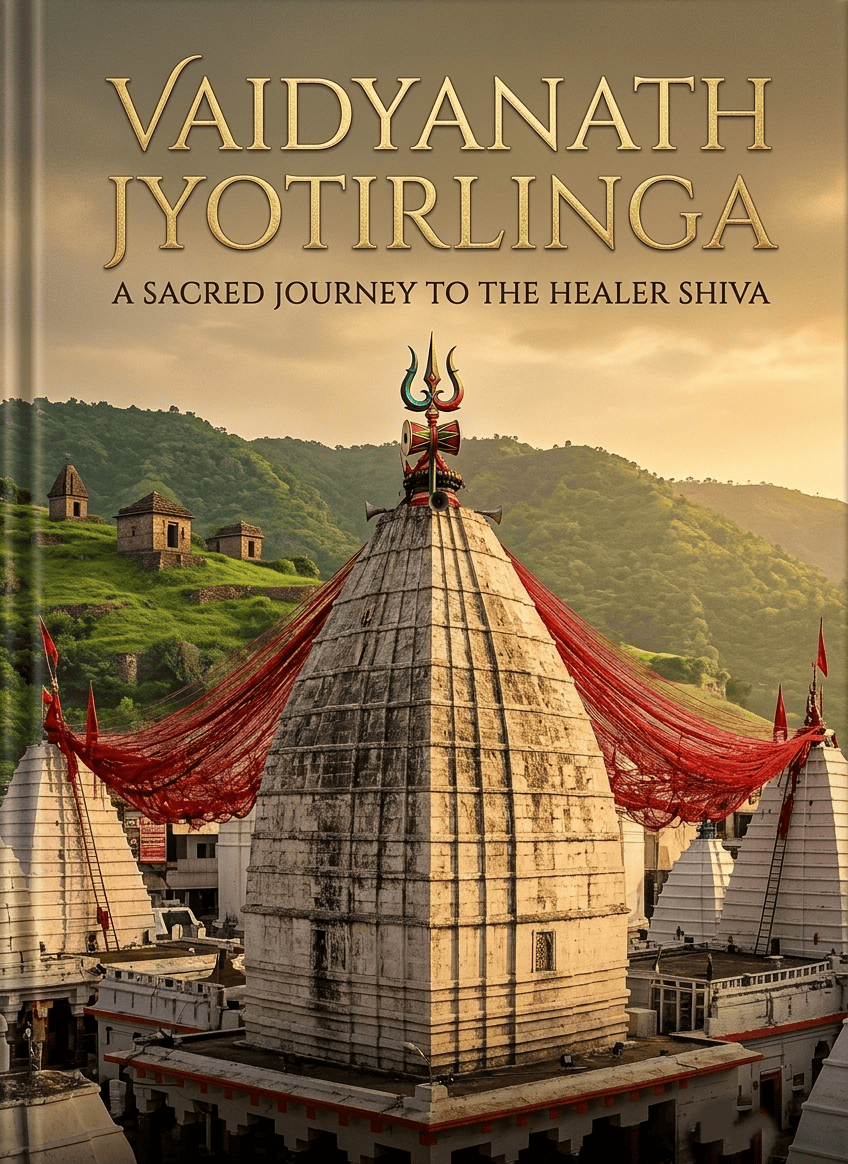
SHRI VAIDYANATH
JYOTIRLINGA
CHAPTER NINE
Om Namah
Shivaya
-----------------------------------
INTRODUCTION
"Salutations
to Lord Ganesha. Today, I narrate to you the wonderful story of Vaidyanath –
the ninth among the twelve Jyotirlingas."
This is not
merely a story – it is the tale of Ravan's devotion, the tale of Shiva's grace,
and that divine play of Shiva as the Vaidya (physician), which teaches us – the
sole healer of the disease of worldly existence is Lord Shiva himself.
----------------------------------
CHAPTER ONE
VAIDYANATH –
SHIVA AS THE DIVINE PHYSICIAN
"Vaidyanath"
– meaning "the Lord of Physicians" – the master of healers.
Lord Shiva
is worshipped in this Jyotirlinga as the Vaidya (physician). It is believed –
having darshan here liberates one from diseases.
"Vaidyanath
Dham has been called 'Bhavarogahara' – the destroyer of the disease of worldly
existence."
----------------------------------
CHAPTER TWO
DEOGHAR –
THE ABODE OF THE GODS
The
Vaidyanath Jyotirlinga is located in the Deoghar district of Jharkhand state.
"Deoghar"
– meaning "the abode of the gods".
This holds
the fifth position among the twelve Jyotirlingas.
It is also
one of the 51 Shakti Peethas – it is believed that Mother Sati's heart fell
here.
It is a
confluence of both Shiva and Shakti.
------------------------------------
CHAPTER
THREE
RAVAN'S
DEVOTION – THE SACRIFICE OF TEN HEADS
In ancient
times, the king of Lanka, Ravan, was a supreme devotee of Lord Shiva.
Ravan went
to Mount Kailash and performed intense penance to Lord Shiva. His penance was
so powerful that –
"He cut
off his ten heads one by one and offered them on the Shivalinga."
When Ravan
was about to cut off his tenth head after cutting the ninth, Lord Shiva
appeared.
Shiva asked Ravan
to ask for a boon.
----------------------------------
CHAPTER FOUR
RAVAN'S BOON
– THE DEMAND FOR THE ATMALINGA
Ravan said –
"O
Lord! Grant me your Atmalinga. I shall take it to Lanka and establish it
there."
Ravan's
objective was –
To make
Lanka invincible.
To invite
Lord Shiva to reside permanently in Lanka.
To establish
his dominion over all three worlds.
Lord Shiva
gave him the Atmalinga, but placed a condition –
"Do not
place this linga anywhere on the ground. If you do, it will become fixed and
will not move from there."
----------------------------
CHAPTER FIVE
GANESHA'S
DECEPTION – THE LINGA BECOMES FIXED ON EARTH
Ravan set
off towards Lanka in his Pushpaka Vimana with the Atmalinga.
The gods did
not like this – if Ravan took the linga to Lanka, he would become invincible.
The gods prayed
to Varuna Deva. Varuna Deva entered Ravan's stomach and compelled him to answer
nature's call.
Ravan had to
descend from the vimana. He handed the linga to a boy (who was Ganesha himself)
there and said –
"Do not
place this on the ground. I will be back soon."
Ganesha
placed the linga on the ground and disappeared.
--------------------------
CHAPTER SIX
RAVAN'S ANGER
– THE DISTORTION OF THE LINGA
When Ravan
returned, he saw – the linga had already become fixed on the ground.
He tried
with great effort – but the linga did not move.
In anger, he
pressed the linga with his thumb – which caused a distortion in the middle of
the linga. This is why the linga of Vaidyanath is different from other lingas.
Ravan
repented. He began worshipping Shiva there and got a pond (Chandrakup)
constructed.
-----------------------
CHAPTER
SEVEN
THE NAME
VAIDYANATH – SHIVA AS THE DIVINE HEALER
Lord Shiva
reattached Ravan's severed heads – like a Vaidya (physician).
"Thus,
Shiva came to be known as 'Vaidyanath' at this place – the Lord of
Physicians."
---------------------
CHAPTER
EIGHT
THE DIVINE
HISTORY OF THE TEMPLE
Mythological
Belief –
This place
is mentioned as "Gokarna" in the Shiva Puran.
The Matsya Puran
(3rd-6th century) calls this place "Arogya Vaidyanathiti" – the place
of freedom from disease.
The Devi
Bhagavata describes it as a Shakti Peetha.
Historical
Background –
The temple
is mentioned in the 8th century (by Gupta king Adityasena).
The present
temple was developed during the Mughal period with the contribution of King Man
Singh.
The temple
faces east, is 72 feet tall, and has a golden kalasha and a Panchashula
installed on it.
-------------------------
CHAPTER NINE
THE TEMPLE'S
ARCHITECTURE AND SPECIAL FEATURES
Temple
Structure –
Style –
North Indian (Nagara style)
Spire – 72
feet tall, pyramidal in shape
Kalasha –
Three golden kalashas
Mani –
Chandrakanta Mani (eight-petalled lotus)
Shakti
Peetha –
It is
believed – Mother Sati's heart fell here. Therefore, it is called the "Hridaya
Peetha" (Heart Shrine).
Other Deities
–
In the
temple complex – Ganpati, Hanuman, Surya, Kalabhairava
------------------------------
CHAPTER TEN
THE SHRAVANI
MELA – THE 108 KM KANWAR YATRA
Vaidyanath
Dham is world-famous for the Shravani Mela.
What is the
Shravani Mela? –
A grand fair
is held here during the month of Shravan (July-August).
7 to 8
million (70 to 80 lakh) devotees gather here.
Kanwariyas
walk 108 kilometers from Sultanganj (on the Ganga bank) to bring Ganga water.
"This
is one of the largest pilgrimages in the world."
Respect for Ravan
–
In Deoghar, Ravan's
effigy is not burned on Dussehra. Because –
Ravan is
respected here as a scholar and devotee of Shiva.
It is
believed – Ravan himself got the Vaidyanath temple established.
Ravan composed
the Shiva Tandava Stotra.
------------------------------------------------------------
CHAPTER
ELEVEN
INTERESTING
FACTS
First –
Vaidyanath is the only one among the 12 Jyotirlingas that is also a Shakti
Peetha.
Second – The
Shivalinga here is believed to have been distorted by Ravan's thumb.
Third – Ravan's
effigy is not burned here on Dussehra.
Fourth –
During the Shravani Mela, devotees walk 108 kilometers to offer Ganga water.
Fifth – It
is believed – having darshan here liberates one from diseases.
--------------------
CHAPTER
TWELVE
THE
SPIRITUAL MESSAGE – THE ESSENCE OF THE STORY
This story
carries a deep spiritual meaning –
1. The Power
of Devotion –
Ravan
pleased Shiva by offering his heads. This teaches – unwavering devotion can
move even Shiva.
2. Shiva's
Grace –
Shiva healed
Ravan by reattaching his heads. This teaches – Shiva removes the afflictions of
all.
3. The End
of Ego –
Ravan
pressed the linga with his thumb – but it did not move. This teaches – nothing
is achieved through ego.
4. Freedom
from Disease –
Vaidyanath
destroys the disease of worldly existence. This teaches – all suffering is removed
by seeking refuge in Shiva.
--------------------------------
CHAPTER
THIRTEEN
CONCLUSION
This story
of the Vaidyanath Jyotirlinga teaches us –
"The
sole healer of the disease of worldly existence is Lord Shiva himself.
Vaidyanath – where Shiva reattached Ravan's severed heads, where Mother Sati's
heart fell, where millions of Kanwariyas offer Ganga water in the month of
Shravan – this place is a wonderful confluence of devotion, faith, and Shiva's
grace."
Whoever
remembers Vaidyanath with devotion, attains freedom from disease, peace, and
salvation – all three.
This is the
story of Vaidyanath... this is the glory of the ninth Jyotirlinga.
Om Namah
Shivaya.
Jai
Vaidyanath.
Jai Baba Baidyanath.
— The End —