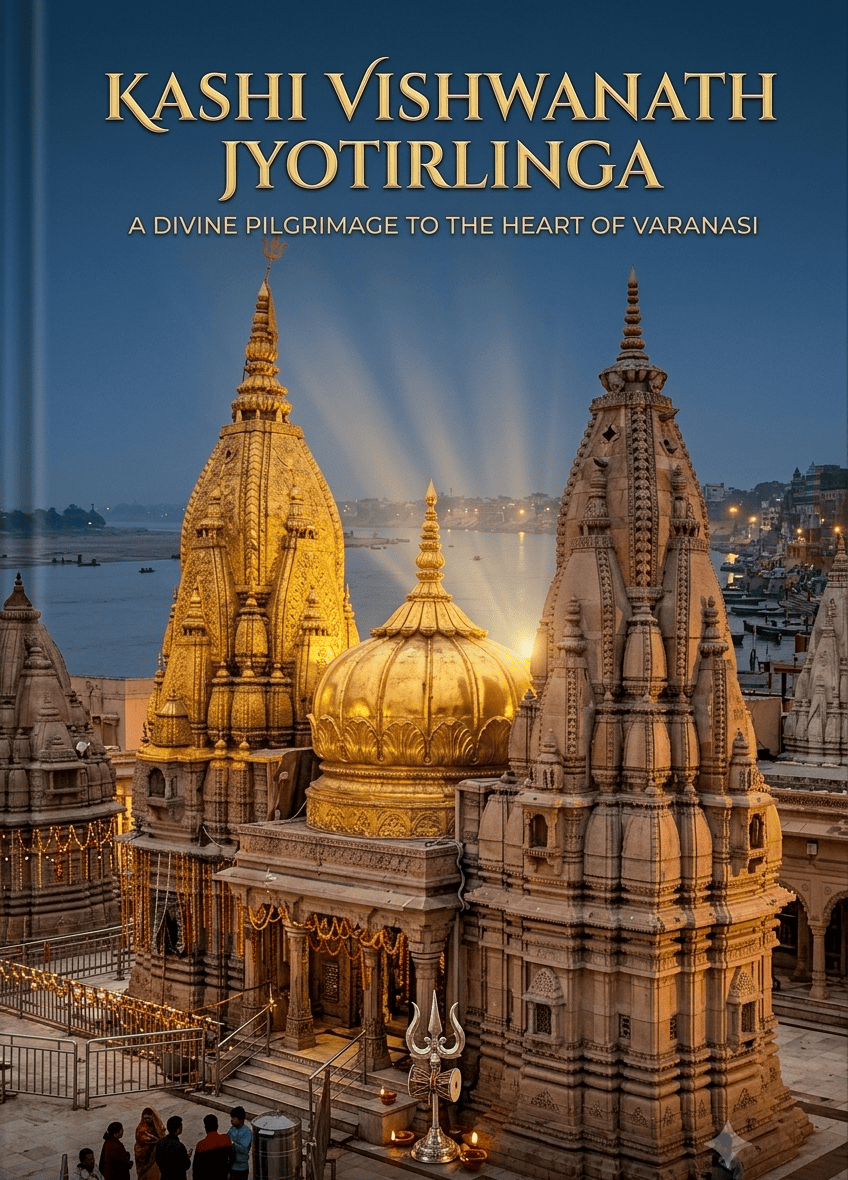
SHRI KASHI
VISHWANATH JYOTIRLINGA
CHAPTER
SEVEN
Om Namah
Shivaya
---------------------
INTRODUCTION
"Salutations
to Lord Ganesha. Today, I narrate to you the wonderful story of Kashi
Vishwanath – the seventh among the twelve Jyotirlingas."
This is not
merely a story – it is the tale of liberation, the tale of the destruction of
sins, and that divine play of Shiva's grace which teaches us – for one who dies
in Kashi, Shiva himself bestows the 'Taraka Mantra' and grants liberation.
------------------------------
CHAPTER ONE
KASHI – ANANDVAN,
THE LAND OF LIBERATION
This is a
very ancient tale... when even the gods longed for the sanctity of Kashi.
Kashi –
which is also called Varanasi – is the most ancient city of India. It is
situated on the banks of the Ganga river.
Kashi is
known by many names –
"Anandvan"
– the forest of bliss
"Muktikshetra"
– the land of liberation
"Shivapuri"
– the city of Shiva
"Avimukta"
– where Shiva never abandons
"Kashi
has been called 'heaven on earth'. Whoever comes here becomes blessed."
--------------------
CHAPTER TWO
KASHI – BRAHMA'S
YAJNA AND SHIVA'S ARRIVAL
In ancient
times, Brahma ji organized a grand yajna in Kashi. All the gods were pleased with
the sanctity of the yajna.
But, during
the yajna, a great problem arose. Demons began to create disturbances in the
yajna.
Then Brahma
ji prayed to Lord Shiva –
"O
Lord! Protect this place. May you reside here forever."
Lord Shiva
was pleased and made Kashi his eternal abode.
"Ever
since then, Kashi has been called the city of Shiva."
---------------------
CHAPTER
THREE
KASHI VISHWANATH
– THE LORD OF THE UNIVERSE
"Vishwanath"
– meaning "the Lord of the Universe".
Lord Shiva
resides in Kashi as "Vishwanath" – he is the master of the entire
universe.
"Just
as a king resides in his capital, similarly Shiva resides in his city –
Kashi."
-----------------------
CHAPTER FOUR
THE TARAKA
MANTRA – LIBERATION AT THE MOMENT OF DEATH
The greatest
specialty of Kashi is this –
"One
who dies in Kashi, Shiva himself imparts the 'Taraka Mantra' to them."
What is the
Taraka Mantra?
The Taraka
Mantra is – "Rama" or "Om Namah Shivaya".
It is
believed – at the time of death, Lord Shiva himself whispers the Taraka Mantra
into the ear of the deceased and grants liberation to their soul.
"This
is precisely why Kashi is called the 'gateway to liberation'."
-----------------------
CHAPTER FIVE
THE SANCTITY
OF KASHI – THE DESTRUCTION OF SINS
The sanctity
of Kashi is described in great detail in the scriptures.
Ganga Snan
(Holy Dip) –
Taking a dip
in the Ganga destroys sins.
It is
believed – a single dip in the Ganga washes away the sins of many lifetimes.
Ganga Aarti
–
The Ganga
Aarti is performed daily at the Dashashwamedh Ghat.
This aarti
is extremely grand and worth witnessing.
Thousands of
devotees participate in it.
Manikarnika
Ghat –
This is the
main cremation ghat.
It is
believed – cremation here grants direct liberation.
-------------------------------------
CHAPTER SIX
THE DIVINE
HISTORY OF THE TEMPLE
Mythological
Belief –
Kashi
Vishwanath is mentioned in the Shiva Puran, Skanda Puran, and Padma Puran.
The
Kashi-Khanda of the Skanda Puran is entirely dedicated to the glory of Kashi.
Historical
Background –
The present
temple was built in 1780 by Ahilyabai Holkar.
The temple's
spire is made of gold – which was built by Maharaja Ranjit Singh.
This temple
was destroyed many times and rebuilt many times.
Attacks and
Rebuilds –
In 1194 –
Qutb-ud-din Aibak destroyed the temple.
In 1669 –
Aurangzeb destroyed the temple and built the Gyanvapi Mosque.
In 1780 –
Ahilyabai Holkar got the present temple constructed.
"Faith
rebuilt devotion every single time."
--------------------
CHAPTER
SEVEN
THE TEMPLE'S
ARCHITECTURE AND SPECIAL FEATURES
The
architecture of the Kashi Vishwanath temple is extremely grand.
Temple
Structure –
Style –
North Indian (Nagara style)
Spire – Golden
spire – 15.5 meters high
Sanctum
Sanctorum – Houses the Shivalinga – self-manifested
Courtyard –
Limited space, but extremely sacred
Gyanvapi
Well –
The Gyanvapi
well is located in the temple complex.
It is
believed – this is the well of knowledge.
It is said –
the Shivalinga was hidden in this well.
Other
Deities –
In the
temple complex – Mother Parvati, Lord Ganesha, Lord Vishnu, Nandi
---------------------
CHAPTER
EIGHT
THE 12 GHATS
OF KASHI – SACRED BATHING PLACES
There are
many ghats on the Ganga river in Kashi. Each ghat has its own specialty.
1.
Dashashwamedh Ghat – The most famous, where the Ganga Aarti is performed
2.
Manikarnika Ghat – The ghat of liberation, the cremation ground
3.
Harishchandra Ghat – The ghat of the truthful king Harishchandra
4. Assi Ghat
– Where Ramlila is performed
5.
Panchganga Ghat – The confluence of five rivers
6. Kedar
Ghat – Associated with Kedarnath
7. Tulsi Ghat
– The place of Tulsidas ji
------------------------
CHAPTER NINE
KASHI AND
TULSIDAS – THE RAMCHARITMANAS
Goswami
Tulsidas composed the Ramcharitmanas in Kashi itself.
"Tulsidas
composed the Rama Katha right here. Even today, that place here is called
'Tulsi Ghat'."
----------------------
CHAPTER TEN
KASHI'S
FAMOUS SCHOLARS AND SAINTS
Kashi has
been a center of knowledge and learning. Many great scholars have lived here –
Adi
Shankaracharya – propagated knowledge here.
Tulsidas –
wrote the Ramcharitmanas.
Kabir –
imparted teachings here.
Ravidas –
was a great saint of here.
----------------------------
CHAPTER
ELEVEN
FESTIVALS
AND SPECIAL RITUALS
Maha
Shivaratri –
On Maha
Shivaratri, a grand procession is taken out here.
Thousands of
devotees gather here.
Rudrabhishek
and japa are performed.
Dev
Deepawali –
On Kartik
Purnima, Dev Deepawali is celebrated.
Thousands of
lamps are lit on the ghats of the Ganga.
This sight
is extremely grand and divine.
Ganga Aarti
–
The Ganga
Aarti is performed every evening.
This is
world-famous.
Thousands of
devotees participate in it.
The Kashi
Naresh's Procession –
Every year,
the grand procession of the Kashi Naresh is taken out.
This
tradition has been continuing for hundreds of years.
---------------------------
CHAPTER
TWELVE
INTERESTING
FACTS
First –
Kashi is the most ancient city in the world – 3,000 years old.
Second – Kashi
is one of the 12 Jyotirlingas – Vishwanath.
Third – The
Shivalinga here is self-manifested – that is, it appeared on its own.
Fourth – It
is believed – dying in Kashi leads to liberation.
Fifth – The
golden spire of the temple was built by Maharaja Ranjit Singh.
Sixth – The
Gyanvapi well here is considered extremely sacred.
----------------------------
CHAPTER
THIRTEEN
THE
SPIRITUAL MESSAGE – THE ESSENCE OF THE STORY
This story
carries a deep spiritual meaning –
1. Do Not
Fear Death –
Kashi
teaches us – do not fear death. It is only the end of the body, not of the
soul.
2. The Path
to Liberation –
Kashi is the
gateway to liberation. This teaches – devotion, knowledge, and seeking refuge
in Shiva lead to liberation.
3. The
Purity of the Ganga –
Taking a dip
in the Ganga purifies us – both externally and internally.
4. Shiva's
Compassion –
Shiva
himself grants liberation at the time of death. This teaches – Shiva's grace is
limitless, which opens the door to liberation for all.
--------------------------
CHAPTER
FOURTEEN
CONCLUSION
This story
of the Kashi Vishwanath Jyotirlinga teaches us –
"Kashi
– where sins are destroyed, where Shiva himself grants liberation. The darshan
of Kashi Vishwanath is the completeness of life. This place gives us liberation
from death and the experience of Shiva's grace."
Whoever
remembers Kashi Vishwanath with devotion, attains liberation from sins,
salvation, and Shiva's grace – all three.
This is the
story of Kashi Vishwanath... this is the glory of the seventh Jyotirlinga.
Om Namah
Shivaya.
Jai Kashi
Vishwanath.
Jai Maa
Ganga.
— The End —