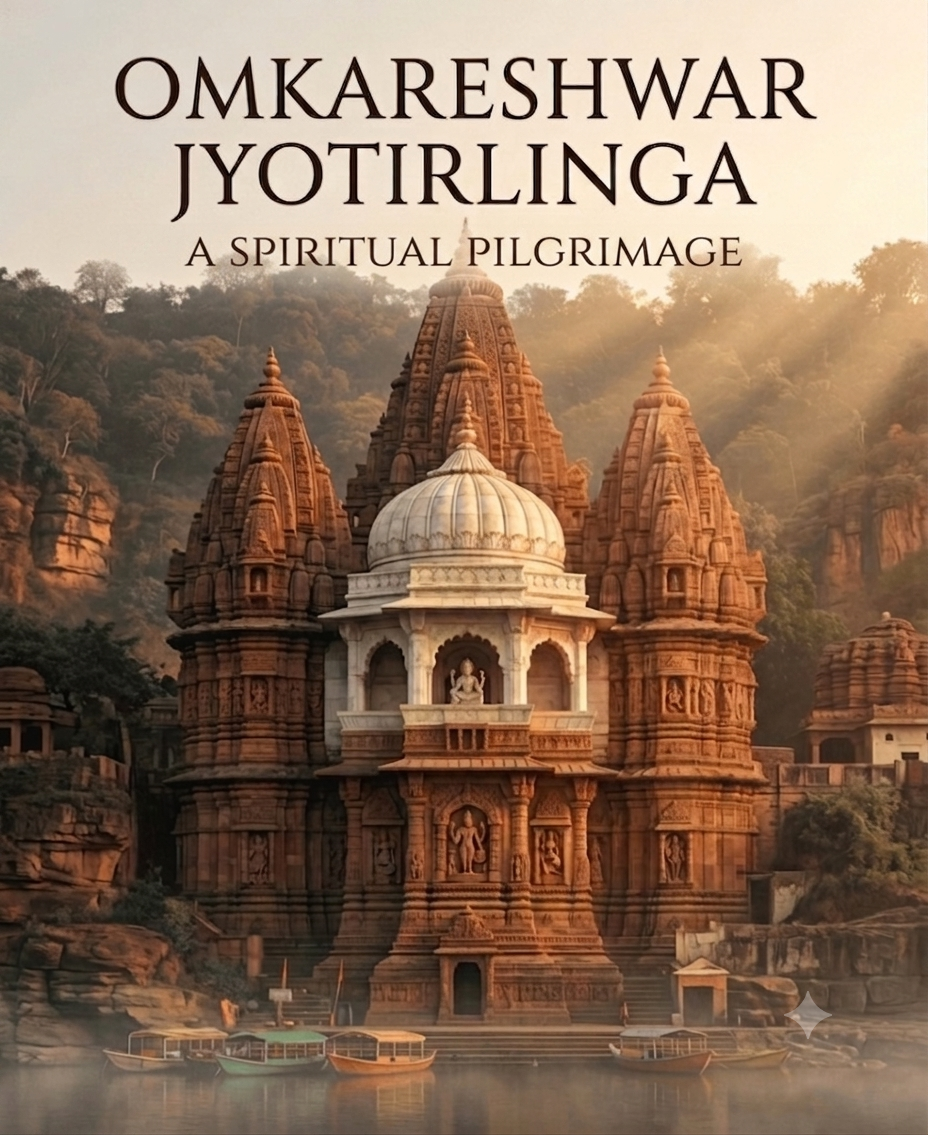
SHRI
OMKARESHWAR JYOTIRLINGA
CHAPTER FOUR
Om Namah
Shivaya
-------------------------
INTRODUCTION
"Salutations
to Lord Ganesha. Today, I narrate to you the wonderful story of Omkareshwar –
the fourth among the twelve Jyotirlingas."
This is not
merely a story – it is the tale of Pranava (Om), the tale of the Narmada, and
that divine play of the oneness of Shiva and Omkara, which teaches us – 'Om'
itself is Brahman, and Brahman itself is Shiva.
--------------------
CHAPTER ONE
OM – THE
SEED OF ALL MANTRAS
This is a
very ancient tale... when creation came into being, the very first sound that emerged
was the Pranava – 'Om'.
'Om' is that
primordial mantra from which all the Vedas, all the scriptures, and the entire
universe originated.
"Om"
– this is the sound-form of Brahman. This is the seed mantra of Shiva.
Omkareshwar
is the direct manifestation of this 'Om'. This is the place where Shiva,
appearing in the form of 'Om', granted his vision to his devotees.
----------------------
CHAPTER TWO
THE NARMADA
– THE DIVINE RIVER AND MANDATA ISLAND
Omkareshwar
is situated in the middle of the Narmada river. This place is called Mandata
Island.
The
Significance of the Narmada –
The Narmada
has been called the 'mother of sacred rivers'. It is said – "Merely having
darshan of the Narmada destroys sins."
Mandata
Island – The Shape of Om –
When viewed
from above, this island resembles the shape of 'Om'. This is precisely why this
place came to be known as Omkareshwar.
This is the
only Jyotirlinga that is situated on an island in a river. This feature makes
it unique.
------------------
CHAPTER THREE
THE PENANCE
OF THE SAGES AND PRAYERS TO SHIVA
In ancient
times, many sages and devotees lived on the banks of the Narmada. They would
bathe in the Narmada daily, perform yajnas and havans, and meditate upon Shiva.
One day, all
the sages gathered and began to think – "We all worship Shiva, but can he
not remain with us forever?"
Then all the
sages together prayed to Lord Shiva – "O Lord! May you forever reside on
this bank of the Narmada."
-----------------------
CHAPTER FOUR
SHIVA'S
MANIFESTATION – THE EMERGENCE OF OMKARESHWAR
Lord Shiva
was extremely pleased with the prayers of his devotees. He manifested on
Mandata Island, in the middle of the Narmada.
He assumed
two forms –
1.
Omkareshwar – (in the form of Om)
2. Amleshwar
/ Mamleshwar – (the second form)
Both forms
reside at different locations, but both share the same name – Omkareshwar.
"This
is why Omkareshwar is divided into two parts – one is Omkareshwar, the other is
Amleshwar."
-----------------------------
CHAPTER FIVE
OMKARESHWAR
AND AMLESHWAR – TWO FORMS, ONE SOUL
1.
Omkareshwar –
This is the
main Jyotirlinga, located in the southern part of Mandata Island. The
Shivalinga here is self-manifested and is believed to be in the shape of 'Om'.
2. Amleshwar
(Mamleshwar) –
This is
located in the northern part of Mandata Island. It is also called 'Mamleshwar',
because according to one legend – Mama (mother) worshipped Shiva here.
Both temples
are symbols of the same sanctity and the same power.
----------------------
CHAPTER SIX
THE NARMADA
PARIKRAMA – A UNIQUE TRADITION
Omkareshwar
has a special tradition of the Narmada Parikrama.
What is the
Narmada Parikrama?
It is a
pilgrimage on foot along both banks of the Narmada river.
It is
approximately 2,600 kilometers long.
It takes 3
to 4 years to complete.
This entire
journey is a symbol of Shiva devotion and self-discipline.
Why?
It is
believed – performing the Narmada Parikrama destroys sins of many lifetimes and
leads to liberation.
"This
is considered the longest pilgrimage in the world – and it begins from
Omkareshwar."
--------------------------------
CHAPTER
SEVEN
THE DIVINE
HISTORY OF THE TEMPLE
Mythological
Belief –
Omkareshwar
is mentioned in the Shiva Purana, Skanda Purana, and Linga Purana.
It is
believed that Lord Rama also worshipped here. It is said – Rama installed and
worshipped a Shivalinga on the banks of the Narmada.
Historical
Background –
The temple
was built in the 9th-10th century.
The Paramara
kings developed this temple.
The Holkar
and Scindia rulers also got it renovated.
Worship
continued here even during the Mughal period.
--------------------
CHAPTER
EIGHT
THE TEMPLE'S
ARCHITECTURE AND SPECIAL FEATURES
The
architecture of the Omkareshwar temple is extremely grand and ancient.
Temple
Structure –
Style –
Nagara style (North Indian)
Sanctum
Sanctorum – Houses the Shivalinga – self-manifested, Om-shaped
Spire –
Massive and grand, with a golden kalasha
Courtyard –
Very large, with space for thousands of devotees
Other
Deities –
The temple
complex also houses other temples –
Siddhanath –
a form of Mahadeva
Mother
Parvati, Lord Ganesha, Nandi
Special
Feature –
The temple
is situated on an island in the middle of the Narmada.
It is
surrounded by water.
One has to
use a boat or a bridge to reach it.
This is the
only one among the 12 Jyotirlingas that is on a river island.
----------------------------
CHAPTER NINE
OTHER BELIEFS
ASSOCIATED WITH OMKARESHWAR
1. The
Mystery of Om –
Omkareshwar
is itself a symbol of 'Om'. The Shivalinga here is believed to be in the shape
of 'Om'.
"Whoever
chants Om, attains Shiva – this is the principle."
2.
Pancha-Jyotirlinga –
It is
believed – five Jyotirlingas exist together here –
Omkareshwar,
Amleshwar, Siddhanath, Brahma, Vishnu
This is why
it is also called the "Pancha-Jyotirlinga site".
3. Narmada
Snan (Holy Dip) –
Taking a dip
in the Narmada here has special significance. It is believed – taking a dip in
the Narmada washes away all sins.
----------------------
CHAPTER TEN
MAHASHIVARATRI
AND OTHER FESTIVALS
Maha
Shivaratri –
On Maha Shivaratri,
special aarti and Rudrabhishek are performed here. Thousands of devotees gather
here.
Shravan
Month –
During the
month of Shravan, the Monday fasts hold special significance here. Devotees
bring water from the Narmada and perform abhishek on the Shivalinga.
Kartik
Purnima –
On Kartik
Purnima, a grand festival of lamps (Deepotsav) is celebrated here. Thousands of
lamps are lit on the banks of the Narmada.
Navaratri –
During
Navaratri, special worship of Mother Parvati is performed.
-----------------------
CHAPTER
ELEVEN
INTERESTING
FACTS
First – This
is the only Jyotirlinga situated on an island in a river.
Second –
When viewed from above, the island here resembles the shape of 'Om'.
Third – Two
Jyotirlingas exist here together – Omkareshwar and Amleshwar.
Fourth – The
Narmada Parikrama begins from Omkareshwar.
Fifth –
There is a separate temple of Mother Narmada here.
Sixth – It
is believed – having darshan here bestows the attainment of 'Om'.
------------------------------
CHAPTER
TWELVE
THE SPIRITUAL
MESSAGE – THE ESSENCE OF THE STORY
This story
carries a deep spiritual meaning –
1. The
Importance of Om –
Omkareshwar
teaches us – 'Om' is the seed of all mantras. 'Om' itself is Brahman. 'Om'
itself is Shiva.
2. The
Purity of the Narmada –
The holy dip
in the Narmada teaches us to purify both the outside and the inside.
3. Duality
and Non-Duality –
Omkareshwar
and Amleshwar – two forms, one soul. This teaches – there are two names, but
one essence.
4. Penance
and Devotion –
The penance
of the sages made Shiva manifest. This teaches – true penance surely brings
Shiva's presence.
----------------------------
CHAPTER
THIRTEEN
CONCLUSION
This story
of the Omkareshwar Jyotirlinga teaches us –
"'Om'
itself is Brahman, and Brahman itself is Shiva. Omkareshwar is the direct
manifestation of this 'Om'. Whoever chants Om, attains Shiva. The purity of the
Narmada and the penance of the sages have made this place immortal."
Whoever
remembers Omkareshwar with devotion, attains the mastery of Om, wisdom, and liberation
– all three.
This is the
story of Omkareshwar... this is the glory of the fourth Jyotirlinga.
Om Namah
Shivaya.
Jai
Omkareshwar.
Jai Maa
Narmada.
— The End —