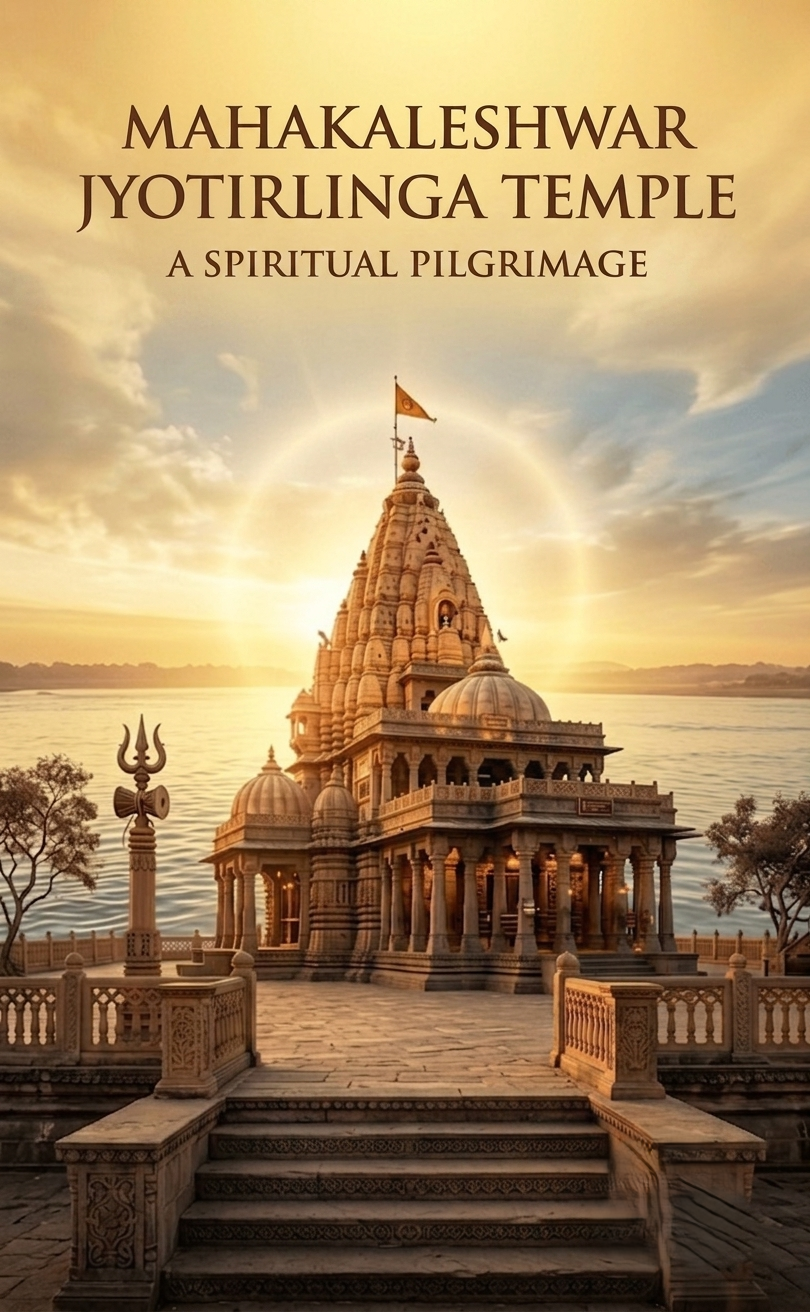
SHRI
MAHAKALESHWAR JYOTIRLINGA
CHAPTER
THREE
Om Namah Shivaya
INTRODUCTION
"Salutations
to Lord Ganesha. Today, I narrate to you the wonderful story of Mahakaleshwar –
the third among the twelve Jyotirlingas."
This is not
merely a story – it is the tale of time, the tale of death, and that divine
play of Mahakala – the Lord even of time – which teaches us – for one who seeks
refuge in Mahakala, there is no fear of time.
------------------------
CHAPTER ONE
UJJAIN – THE
ANCIENT CITY OF AVANTIKA
This is a
very ancient tale... when Ujjain was called Avantika.
The city of
Avantika was extremely prosperous and sacred. Here, on the banks of the Shipra
river, lived many sages, Brahmins, and devotees. They would bathe in the river
daily, perform yajnas and havans, and meditate upon Lord Shiva.
All the gods
were pleased with the purity of this city and the penance of its devotees.
But... a terrible calamity was about to befall this city.
-----------------------------
CHAPTER TWO
THE TERROR
OF THE DEMON DUSHANA
Some
distance from Ujjain, in dense forests, lived a demon named Dushana. He was
extremely cruel, powerful, and arrogant.
He thought –
"These sages are making the gods powerful by performing yajnas and havans.
This must be stopped."
Dushana,
along with his army, attacked the city of Avantika. He –
- Destroyed
the hermitages of the sages
- Wrecked
the yajna altars
- Plundered
the royal court
- Terrified
the devotees
All the
sages and devotees gathered in fear. They understood – "Now only Lord
Mahadeva can put an end to this demon."
-------------------------
CHAPTER
THREE
THE PRAYERS
OF THE DEVOTEES AND SHIVA'S APPEARANCE
All the
devotees and sages gathered on the banks of the Shipra river. They called out
to Lord Shiva with one voice –
"O
Lord! Protect us. Save Avantika. The demon Dushana has destroyed all our worship
and rituals."
Hearing the
anguish of his devotees, Lord Shiva was filled with compassion. He understood –
"Now the time has come. I must manifest."
And then –
Lord Shiva appeared.
--------------------------
CHAPTER FOUR
MAHAKALA –
THE LORD EVEN OF TIME
This time,
Lord Shiva did not assume a gentle form. He assumed a fierce form – one that
was extremely terrifying, blazing, and radiant.
His radiance
illuminated all directions. His roar made the entire universe tremble.
The demon
Dushana saw this sight. The ground slipped from beneath his feet. But by now,
it was too late.
Shiva slayed
the demon with his trident. And then he became established as Mahakala.
"Mahakala"
– meaning "the Lord even of time". That is, the one who holds even
time itself under his control.
------------------------------
CHAPTER FIVE
THE MEANING
AND GLORY OF MAHAKALESHWAR
The word
Mahakala is composed of two parts –
"Maha"
– that which is greatest, most powerful.
"Kala"
– time, death, and the lord of dissolution.
Thus –
Mahakala = the time of time itself, the master even of death.
It is
believed that in Mahakaleshwar, Shiva resides in person. Here, he is considered
to be living. Therefore, the aartis and rituals here are extremely special.
------------------
CHAPTER SIX
THE BHASMA
AARTI – A UNIQUE TRADITION
The Bhasma
Aarti of Mahakaleshwar is famous throughout the world. It takes place at 4 AM
in the morning.
What is the
Bhasma Aarti?
This is no
ordinary aarti. In it:
- Ashes from
cremation grounds are used.
- This ash
is brought from the great cremation ground (Mahashamshan).
- This ash
is offered to the Shivalinga.
Why?
It is
believed – Mahakala is extremely fond of ash. He is the lord of dissolution,
and ash is the symbol of dissolution.
"Devotees
come from all over the country and abroad to witness the Bhasma Aarti. This
sight is astonishing, grand, and heart-touching."
-----------------------------------
CHAPTER
SEVEN
THE DIVINE
HISTORY OF THE TEMPLE
Mythological
Belief –
Mahakaleshwar
is mentioned in the Shiva Purana, Skanda Purana, and Padma Purana.
This place
is considered sacred to Brahma, Vishnu, and Mahesh – all three. It is said that
– Brahma performed a yajna here, and Vishnu performed penance here.
Historical
Background –
This temple
was built in the 10th century.
The Paramara
kings developed this temple.
Skandagupta
(of the Gupta dynasty) also mentioned this temple.
Vikramaditya
also worshipped here.
Modern
History –
In 1950,
this temple was renovated.
Today, it is
the largest and most prominent religious site in Ujjain.
-------------------------
CHAPTER
EIGHT
THE TEMPLE'S
ARCHITECTURE AND SPECIAL FEATURES
The
architecture of the Mahakaleshwar temple is underground. This feature makes it
unique.
Temple
Structure –
Style –
Underground, a blend of South Indian and Nagara styles
Sanctum
Sanctorum – Houses the Shivalinga, which is extremely ancient and
self-manifested
Spire –
Massive and grand
Courtyard –
Very large, with space for thousands of devotees
Other
Deities –
The temple
complex also houses other temples –
Lord Ganesha,
Mother Parvati, Lord Vishnu, Nandi
Special
Feature –
The
Shivalinga faces east.
It is
self-manifested – that is, it appeared on its own.
Rudrabhishek
is performed here daily.
----------------------
CHAPTER NINE
THE
CONNECTION BETWEEN MAHAKALESHWAR AND VIKRAMADITYA
According to
a famous legend –
King
Vikramaditya was extremely religious and just. He would worship Mahakaleshwar
daily.
One day, he
thought – "Who can be greater than Mahakala?" Then he asked for a boon
to conquer even death (Kala).
Mahakala blessed
Vikramaditya – "Your name and fame shall remain immortal."
And this is
why even today, the Vikram Samvat – Vikramaditya's calendar – is still in use.
------------------------
CHAPTER TEN
OTHER BELIEFS
ASSOCIATED WITH MAHAKALESHWAR
1. Siddhi
Peetha
Mahakaleshwar
is also called Siddhi Peetha. It is believed – worshipping here grants the
eight siddhis (supernatural powers).
2. Bestower
of Liberation
Having
darshan here leads to liberation. This place is the gateway to salvation.
3. Tantric
Tradition
Mahakaleshwar
is also a center of tantric tradition. Kapalika and Aghora sadhana are
performed here.
4. Nag
Panchami
Special
worship is held here on Nag Panchami. Devotees worship the serpents.
-------------------------
CHAPTER
ELEVEN
INTERESTING
FACTS
First – The
Shivalinga of Mahakaleshwar faces the south – which is extremely rare.
Second – For
the Bhasma Aarti here, 10 to 15 kilograms of ash are used daily.
Third – It
is believed – Kalabhairava is the protector of Mahakala. He resides at the
northern gate of the temple.
Fourth – The
Simhastha Kumbh Mela is held here – which takes place once every 12 years.
Fifth –
Mahakala also has a form called Dhumavati – who is the goddess of dissolution.
Sixth –
There is an underground passage beneath the temple – which is believed to lead
to Patalaloka.
-----------------------
CHAPTER
TWELVE
THE
SPIRITUAL MESSAGE – THE ESSENCE OF THE STORY
This story
carries a deep spiritual meaning –
1. Victory
over Time
Mahakala
symbolizes – even time takes time. For one who seeks refuge in Mahakala, there
is no fear of death.
2. The Power
of Devotion
The prayers
of the devotees made Mahakala manifest. This teaches – true devotion never goes
in vain.
3. The
Destruction of Ego
The demon
Dushana was arrogant. He met his end at the hands of Mahakala. This teaches –
the end of ego is destruction.
4. Rising
Above Time
Mahakala
teaches us – rise above time. Do not fear death. Seek refuge in Shiva.
------------------------
CHAPTER
THIRTEEN
CONCLUSION
This story
of the Mahakaleshwar Jyotirlinga teaches us –
"Time
itself is under Shiva's control. For one who seeks refuge in Mahakala, there is
no fear of time. Ego, anger, and death – all dissolve at his feet."
Whoever
remembers Mahakaleshwar with devotion, attains liberation from life, death, and
time – all three.
This is the
story of Mahakaleshwar... this is the glory of the third Jyotirlinga.
Om Namah
Shivaya.
Jai
Mahakala.
Jai
Mahakaleshwar.
— The End —