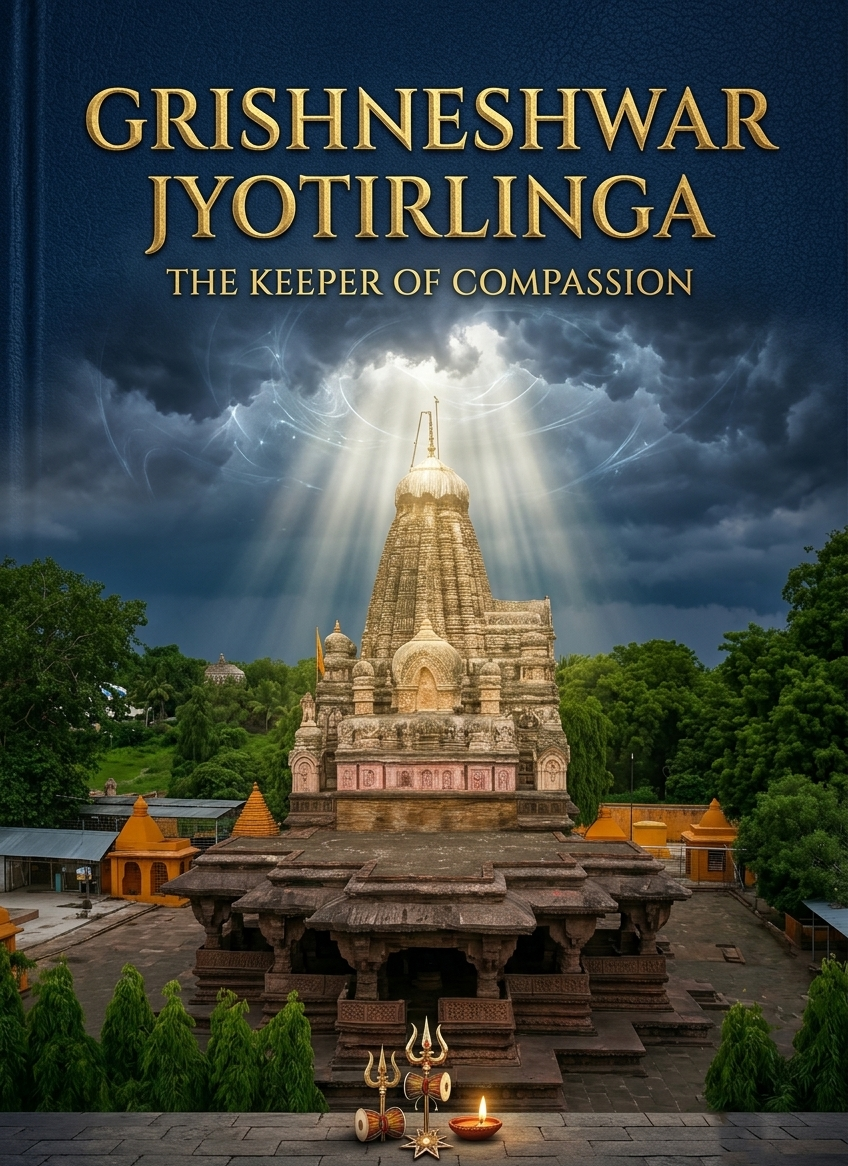
SHRI
GRISHNESHWAR JYOTIRLINGA
CHAPTER
TWELVE
Om Namah
Shivaya
--------------------------
INTRODUCTION
"Salutations
to Lord Ganesha. Today, I narrate to you the wonderful story of Grishneshwar –
the twelfth among the twelve Jyotirlingas."
This is not
merely a story – it is the tale of unwavering devotion, the tale of patience
even in adversity, and that divine play of Shiva's grace which teaches us – for
one who does not forget Shiva even in times of trouble, Shiva himself manifests
and transforms every situation in their life.
----------------------------
CHAPTER ONE
GRISHNESHWAR
– THE CONFLUENCE OF DEVOTION AND ADVERSITY
"Grishneshwar"
– meaning "the Lord of Grishna" (the devotee).
This is the
last – the twelfth – Jyotirlinga among the twelve. It is situated near the world-famous
Ellora (Verul) caves.
"Grishneshwar
is called the symbol of 'living devotion'. The story here teaches us – do not
abandon devotion even in adversity, because the time of Shiva's grace surely
arrives."
---------------------------
CHAPTER TWO
ELLORA –
ANCIENT ART AND SHIVA'S ABODE
The
Grishneshwar Jyotirlinga is located in the Ellora village of the Aurangabad
district in Maharashtra.
It is near
the world-famous Ellora Caves, which are a UNESCO World Heritage Site.
This holds
the twelfth (last) position among the twelve Jyotirlingas.
The
Shivalinga here is self-manifested – that is, it appeared on its own.
This is a
wonderful confluence of the art of three religions – Hindu, Buddhist, and Jain.
---------------------------
CHAPTER
THREE
GRISHNA –
SHIVA'S UNWAVERING DEVOTEE
In ancient
times, a woman named Grishna lived in this region. She was a supreme devotee of
Shiva.
Every day,
she would –
Make 101
Shivalingas,
Worship
them,
And perform
abhishek with ghee (clarified butter).
"Her
devotion was so powerful that she would perform Shiva worship daily without any
interruption."
Because of
her regular worship with ghee, she came to be known as "Grishna" –
meaning "one who worships with ghee
--------------------------
CHAPTER FOUR
JEALOUSY AND
DECEPTION – THE MURDER OF HER SON
Grishna's
devotion began to arouse jealousy in her step-relative.
She thought
–
"She is
becoming very famous because of her devotion. I must stop her."
One day,
while Grishna was absorbed in Shiva worship, her step-relative killed her young
son and threw his body into a well.
"This
incident was extremely tragic – but Grishna did not come to know of it
immediately."
---------------------
CHAPTER FIVE
DEVOTION
EVEN IN ADVERSITY – UNWAVERING FAITH
When Grishna
came to know of her son's death, she was broken from within – but she did not
abandon her devotion to Shiva.
She thought
–
"This
is Shiva's will. I shall complete my worship first, and then see."
She
worshipped all her Shivalingas that day as well, performed abhishek with ghee,
and remembered Shiva in her heart.
"Even
in adversity, she did not abandon her devotion – this was her greatest
quality."
---------------------------------
CHAPTER SIX
SHIVA'S
MANIFESTATION – THE EMERGENCE OF GRISHNESHWAR
Lord Shiva
was extremely pleased with Grishna's unwavering devotion.
Lord Shiva
appeared in the form of a pillar of light. His form was extremely radiant and
divine.
Shiva said –
"O
Grishna! I am pleased with your devotion. You did not forget me even in
adversity."
Shiva, with
his own hand, lifted the dead son from the well and brought him back to life.
"The
dead son was revived – this was a miracle of Shiva's grace!"
Shiva
blessed her –
"I
shall forever reside at this place by the name 'Grishneshwar' – the Lord of
Grishna."
------------------------------
CHAPTER
SEVEN
THE MYSTERY
BEHIND THE NAME GRISHNESHWAR
The word
"Grishneshwar" is composed of two parts –
"Grishna"
– the name of the devotee
"Ishwar"
– Lord, Master
That is –
the Lord of Grishna = Shiva.
Shiva
assumed this name out of love and grace for his devotee Grishna.
"This
is the only Jyotirlinga that is named after a devotee – this is the greatest
glory of devotion!"
-------------------------
CHAPTER
EIGHT
THE DIVINE
HISTORY OF THE TEMPLE
Mythological
Belief –
Grishneshwar
is mentioned in –
The Shiva
Purana (Kotirudra Samhita).
It is also
described in the Skanda Purana.
This is the
last of the twelve Jyotirlingas.
Historical
Background –
The present
temple was built in the 18th century.
Ahilyabai
Holkar got this temple renovated.
The temple
is made of red stone.
It is small,
but extremely sacred.
---------------------
CHAPTER NINE
THE TEMPLE'S
ARCHITECTURE AND SPECIAL FEATURES
The
architecture of the Grishneshwar temple is simple, grand, and ancient.
Temple
Structure –
Style –
North Indian (Nagara style)
Construction
– Made of red stone
Spire – 20
meters high
Sanctum
Sanctorum – Self-manifested Shivalinga – 6 feet high
Temple
Features –
The
Shivalinga faces east.
The
Shivalinga is self-manifested – that is, it appeared on its own.
The temple's
spire is 20 meters high.
There is a
well in the temple complex – where Grishna's son's body was found.
Other
Deities –
In the
temple complex – Mother Parvati, Lord Ganesha, Nandi
----------------------------
CHAPTER TEN
THE ELLORA
CAVES – A WORLD HERITAGE SITE
The
Grishneshwar temple is located near the Ellora Caves – which are a UNESCO World
Heritage Site.
The Ellora
Caves –
There are 34
caves – belonging to Hindu, Buddhist, and Jain religions.
Cave 16 –
The Kailash Temple – is the world's largest monolithic structure.
These caves
were built between the 6th and 10th centuries.
"A
visit to Grishneshwar is considered incomplete without visiting the Ellora
Caves."
-----------------------
CHAPTER
ELEVEN
GRISHNESHWAR
– THE GLORY OF DEVOTION
The
Grishneshwar Jyotirlinga is the greatest symbol of the glory of devotion –
1. Devotion
Even in Adversity –
Grishna did
not abandon Shiva worship even after her son's death. This teaches –
"Do not
forget Shiva even in adversity – because the time of Shiva's grace surely
arrives."
2. Shiva's
Compassion –
Shiva
revived Grishna's son – this teaches –
"Shiva's
grace is limitless – he removes the sorrows of his devotees."
3. The Power
of Devotion –
An ordinary
woman like Grishna manifested Shiva through her devotion – this teaches –
"There
is no caste, class, or gender for devotion – only faith is needed."
--------------------------
CHAPTER
TWELVE
FESTIVALS AND
SPECIAL RITUALS
Maha
Shivaratri –
On Maha
Shivaratri, special aarti and Rudrabhishek are performed here.
Thousands of
devotees gather here.
Shravan
Month –
During the
month of Shravan, the Monday fasts hold special significance.
Devotees
perform abhishek on the Shivalinga.
Navaratri –
During
Navaratri, special worship of Mother Parvati is performed.
----------------------------
CHAPTER
THIRTEEN
INTERESTING
FACTS
First –
Grishneshwar is the last – the twelfth – among the twelve Jyotirlingas.
Second –
This is the only Jyotirlinga that is named after a devotee – Grishna.
Third – It
is situated near the Ellora Caves – which are a UNESCO World Heritage Site.
Fourth – The
Shivalinga here is 6 feet high and self-manifested.
Fifth – The
Shivalinga faces east.
Sixth – It
is believed – having darshan here grants the blessing of progeny.
-------------------------
CHAPTER
FOURTEEN
THE SPIRITUAL
MESSAGE – THE ESSENCE OF THE STORY
This story
carries a deep spiritual meaning –
1.
Unwavering Devotion –
Grishna did
not abandon her devotion even in adversity. This teaches – for one who does not
forget Shiva even in times of trouble, Shiva himself manifests.
2. Patience
in Adversity –
Grishna did
not lose patience even after her son's death. This teaches – patience is the
greatest strength.
3. Shiva's
Compassion –
Shiva
revived Grishna's son. This teaches – Shiva's grace is limitless – he removes
all the sufferings of his devotees.
4. Devotion
is Supreme –
An ordinary
woman like Grishna manifested Shiva. This teaches – there is no high or low in
devotion – only faith is needed.
------------------------
CHAPTER
FIFTEEN
CONCLUSION
This story
of the Grishneshwar Jyotirlinga teaches us –
"For
one who does not forget Shiva even in adversity, Shiva himself manifests – and
transforms every situation in their life. Grishneshwar – where Grishna's
unwavering devotion manifested Shiva, where the dead son was revived, and where
Shiva assumed a Jyotirlinga in the name of his devotee – this place is a
wonderful symbol of devotion, patience, and Shiva's grace."
Whoever
remembers Grishneshwar with devotion, attains the blessing of progeny, the
destruction of sorrows, and Shiva's grace – all three.
This is the
story of Grishneshwar... this is the glory of the twelfth Jyotirlinga.
Om Namah Shivaya.
Jai
Grishneshwar.
Jai
Shiva-Bhakti.
— The End —