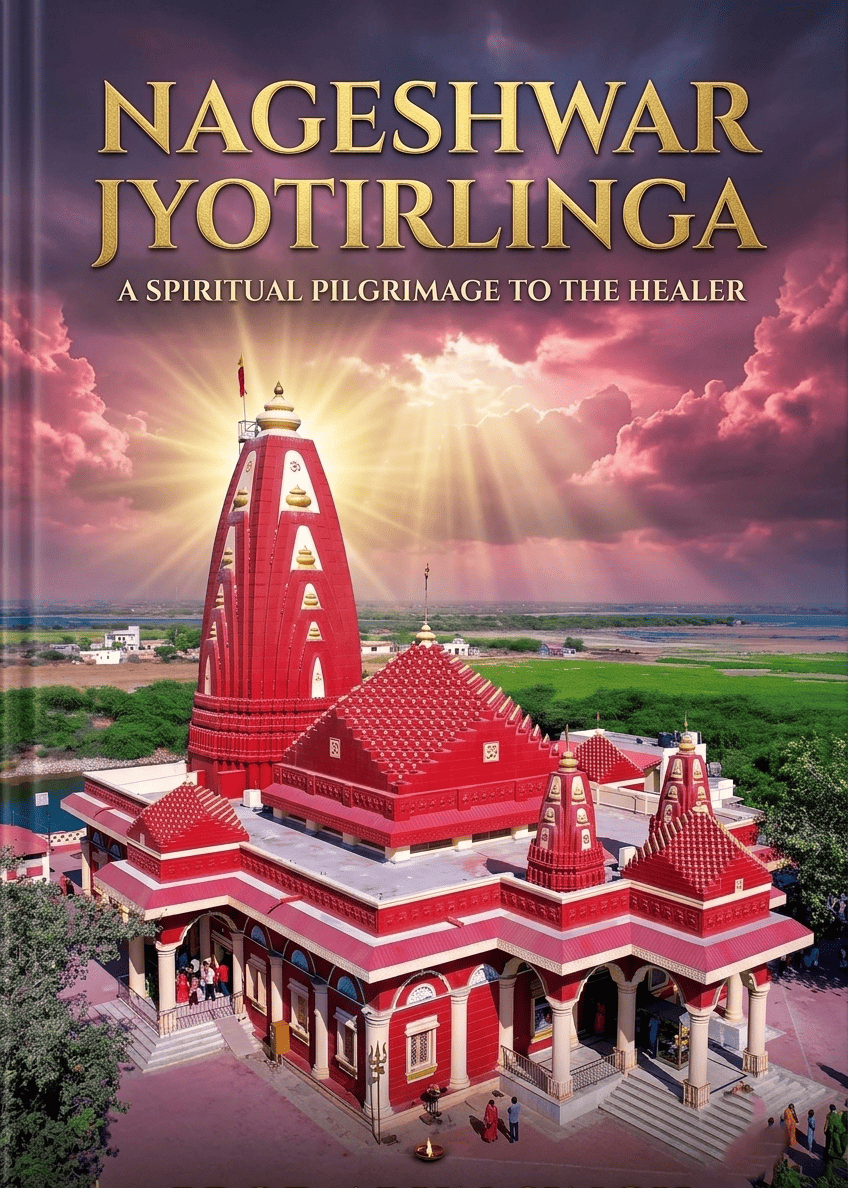
SHRI NAGESHWAR JYOTIRLINGA
CHAPTER TEN
Om Namah Shivaya
--------------------------
INTRODUCTION
"Salutations to Lord Ganesha. Today, I narrate to you the wonderful story of Nageshwar – the tenth among the twelve Jyotirlingas."
This is not merely a story – it is the tale of the power of devotion, the tale of victory over poison and ego, and that divine play of Shiva, the Lord of Serpents, which teaches us – the greatest danger is destroyed before true devotion, and Shiva's name turns poison into nectar.
------------------------
CHAPTER ONE
NAGESHWAR – THE LORD OF SERPENTS
"Nageshwar" – meaning "the Lord of Serpents".
Lord Shiva wears the serpent Vasuki around his neck. This Jyotirlinga is dedicated to that very form of the Lord of Serpents. It is believed – worshipping here protects one from poison and venomous creatures, and the inner poisons – anger, attachment, greed – are also destroyed.
"Nageshwar means – 'the one who turns poison into nectar'. One who has darshan here becomes free from all kinds of poison – both external and internal."
------------------------------
CHAPTER TWO
DWARKA – SHIVA'S ABODE ON THE SEASHORE
The Nageshwar Jyotirlinga is located near the city of Dwarka in the state of Gujarat.
It is situated between the Gomati river and Dwarka, on the coast of Saurashtra.
This holds the tenth position among the twelve Jyotirlingas.
It is believed – Adi Shankaracharya established his western matha here at the Kalika Peetha.
Nearby is the Gopi Talab – which is associated with the pastimes of the gopis and Shri Krishna.
--------------------------------------
CHAPTER THREE
DARUKAVANA – THE FOREST OF THE DEMON
In ancient times, this place was called "Darukavana" – meaning the forest of the demon named Daruka.
In this forest lived a demon couple named Daruka and Daruki.
Daruki (the demoness) had performed intense penance to Mother Parvati.
Mother Parvati was pleased and blessed her – "Your forest shall remain invincible."
Because of this boon, Daruka and Daruki became tyrants.
They captured and imprisoned sages, ascetics, and devotees. They tormented people, destroyed yajnas and havans, and created obstacles in worship and rituals.
-------------------
CHAPTER FOUR
SUPRIYA – SHIVA'S SUPREME DEVOTEE
At that time, there was a merchant named Supriya – who was a supreme devotee of Lord Shiva.
Supriya always wore rudraksha, chanted "Om Namah Shivaya", and remained absorbed in Shiva worship.
One day, the demons captured Supriya too and threw him into the dungeon.
"Even in the dungeon, Supriya did not stop his chanting. He also taught the other prisoners the Shiva mantra."
------------------------
CHAPTER FIVE
THE POWER OF SHIVA'S NAME – THE DESTRUCTION OF POISON
Supriya asked all the prisoners to chant the "Om Namah Shivaya" mantra.
"O friends! There is no protector greater than Shiva's name. Shiva's name turns poison into nectar."
All the prisoners began to chant Shiva's name with one voice.
When the demons saw this, they became enraged. Daruka tried to kill Supriya.
-----------------------------
CHAPTER SIX
SHIVA'S MANIFESTATION – THE EMERGENCE OF NAGESHWAR
Lord Shiva was extremely pleased with Supriya's unwavering devotion and the collective chanting of all the prisoners.
Lord Shiva appeared in the form of a pillar of light. His form was extremely radiant and divine.
He slew the demon Daruka. Thus, he liberated Supriya and the other prisoners.
"Shiva blessed them – 'I shall forever reside at this place by the name Nageshwar. Whoever seeks refuge in me shall be freed from fear and poison.'"
-------------------------------
CHAPTER SEVEN
THE MYSTERY BEHIND THE NAME NAGESHWAR
The word "Nageshwar" is composed of two parts –
"Naga" – serpent, poison, or the lord of serpents
"Ishwar" – God, Lord
That is – the Lord of Serpents = Shiva.
Shiva wears the serpent Vasuki around his neck. He holds poison in his throat and protects the world from poison.
"One who seeks refuge in Nageshwar has no fear of serpents, and the inner poisons – anger, greed, attachment – are also destroyed."
--------------------------
CHAPTER EIGHT
THE DIVINE HISTORY OF THE TEMPLE
Mythological Belief –
Nageshwar is mentioned in the Kotirudra Samhita of the Shiva Puran.
According to the Shiva Puran –
"Pashchime sagare tasya vanam sarvasamriddhimat."
(Meaning – "In the western ocean, his forest was prosperous.")
This is a reference to the forest of Darukavana.
Historical Background –
The temple is made of pink stone.
There is a 25-meter tall giant idol of Lord Shiva here.
The Shivalinga is made of Dwarka stone.
It is shaped like a three-faced rudraksha.
The Shivalinga faces south, while the temple faces east.
------------------
CHAPTER NINE
THE STORY OF NAMDEV – THE SOUTH-FACING SHIVALINGA
A wonderful story is associated with Saint Namdev –
Once, Saint Namdev was singing bhajans. Some devotees told him –
"Namdev! Do not stand in front of us. You are hiding the Shivalinga."
Namdev said –
"Show me the direction where God is not present. I shall go there."
The devotees became angry. They asked Namdev to go and stand in the south direction – because they thought God was not there.
But... when they returned to the temple, they saw – the Shivalinga had itself turned towards the south!
"This is precisely why the Shivalinga of Nageshwar faces south – which is extremely rare."
----------------------------------
CHAPTER TEN
THE TEMPLE'S SPECIAL FEATURES
Temple Structure –
Style – North Indian – grand, built of pink stone
Idol – 25-meter tall Shiva idol
Shivalinga – Made of Dwarka stone, shaped like a three-faced rudraksha
Direction – Shivalinga faces south, temple faces east
Other Deities –
In the temple complex – Mother Parvati, Lord Ganesha, Hanuman, Nandi
Shakti Peetha –
It is believed – this is one of the 52 Shakti Peethas. Adi Shankaracharya established his western matha here at the Kalika Peetha.
-------------------------------
CHAPTER ELEVEN
NAGESHWAR – THE PLACE OF FREEDOM FROM POISON
Nageshwar is considered the Jyotirlinga that destroys poison. Beliefs include –
1. Protection from External Poison –
Protection from snakebites.
Freedom from fear of venomous creatures.
2. Destruction of Inner Poison –
Anger – which burns the mind
Greed – which disturbs the mind
Attachment – which binds the mind
Ego – which blinds the soul
"It is believed – worshipping Nageshwar destroys both physical and spiritual 'poison'."
------------------------------------------------------------
CHAPTER TWELVE
FESTIVALS AND SPECIAL RITUALS
Maha Shivaratri –
On Maha Shivaratri, a grand fair is held here.
Thousands of devotees gather here.
Rudrabhishek and japa are performed.
Shravan Month –
During the month of Shravan, the Monday fasts hold special significance.
Devotees bring seawater and perform abhishek on the Shivalinga.
Navaratri –
During Navaratri, special worship of Mother Parvati is performed.
Gopi Talab –
Near the temple is the Gopi Talab, where the gopis used to come to meet Shri Krishna.
This place is associated with the pastimes of Shri Krishna.
------------------------------------------
CHAPTER THIRTEEN
THE LOCATION CONTROVERSY – THE MYSTERY
There is some controversy regarding the location of the Nageshwar Jyotirlinga.
According to the Shiva Puran, it is located in Darukavana – which was on the western ocean (the Arabian Sea).
Some scholars consider Jageshwar (Uttarakhand) to be Nageshwar.
Some consider Nagnath (Maharashtra) to be Nageshwar.
The majority belief – the Nageshwar near Dwarka is counted among the 12 Jyotirlingas.
---------------------------------------------------------
CHAPTER FOURTEEN
INTERESTING FACTS
First – Nageshwar is one of the 12 Jyotirlingas located in Gujarat.
Second – The 25-meter tall giant idol of Lord Shiva here is visible from afar.
Third – The Shivalinga faces south – which is extremely rare.
Fourth – The Shivalinga is shaped like a three-faced rudraksha.
Fifth – The temple is made of pink stone.
Sixth – It is believed that Shri Krishna also performed Rudrabhishek here.
------------------------
CHAPTER FIFTEEN
THE SPIRITUAL MESSAGE – THE ESSENCE OF THE STORY
This story carries a deep spiritual meaning –
1. The Power of Shiva's Name –
Supriya did not stop chanting Shiva's name even in the dungeon. This teaches – do not abandon Shiva's name even in the most difficult circumstances.
2. Freedom from Poison –
Nageshwar teaches us – the inner poisons – anger, greed, attachment, ego – are also destroyed by seeking refuge in Shiva.
3. The Power of Devotion –
Collective chanting made Shiva manifest. This teaches – the power of true devotion and collective resolve is immense
4. The Destruction of Ego –
The demons tormented devotees out of ego – but Shiva destroyed them. This teaches – the end of ego is always destruction.
-----------------------------
CHAPTER SIXTEEN
CONCLUSION
This story of the Nageshwar Jyotirlinga teaches us –
"There is no protector greater than Shiva's name. Shiva's name turns poison into nectar. Nageshwar – where Shiva protected his devotee Supriya, where the Lord of Serpents resides – this place is a wonderful gateway to devotion, faith, and Shiva's grace."
Whoever remembers Nageshwar with devotion, attains freedom from poison, freedom from fear, and peace – all three.
This is the story of Nageshwar... this is the glory of the tenth Jyotirlinga.
Om Namah Shivaya.
Jai Nageshwar.
Jai Baba Nagnath.
— The End —