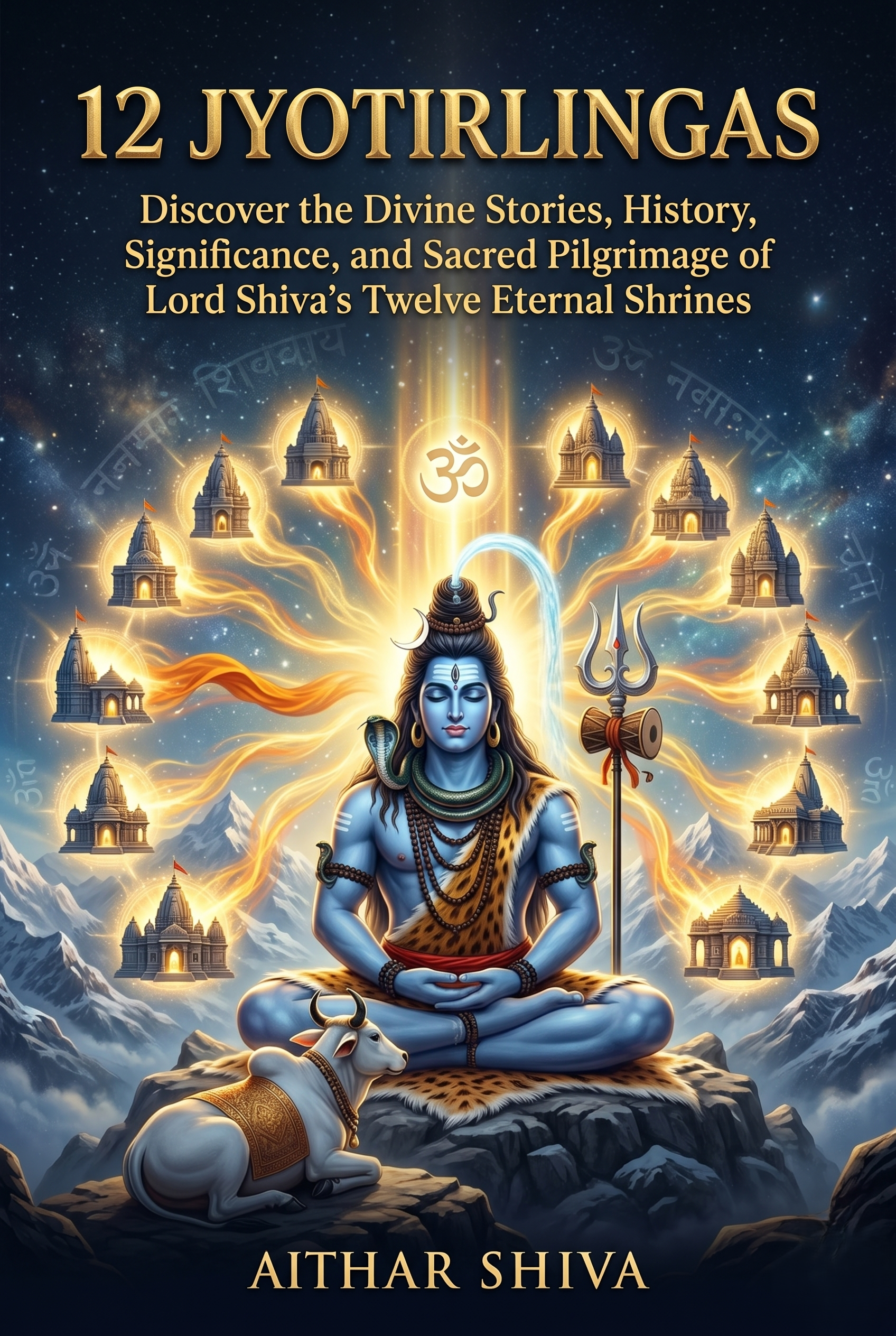
THE DWARKADHISH JYOTIRLINGA
The Twelve Sacred Pillars of Light
Salutations to Lord Ganesha.
Salutations to Goddess Saraswati.
Salutations to the Guru.
Today's subject is – the Dwadash Jyotirlinga. That is, the twelve Jyotirlingas.
This is no ordinary narrative. This is the story, listening to which purifies the mind. This is the story, listening to which a tradition thousands of years old descends into your heart.
So, all of you, please be calm. Keep your mind focused in one place. And listen to this story as if you yourself are undertaking a journey to those twelve divine sites.
-------------------------
CHAPTER ONE: WHAT ARE JYOTIRLINGAS?
The word "Jyotirlinga" is composed of two words – Jyoti and Linga.
Jyoti means – light, divine radiance, that light which manifests from itself, which has no need of the sun or the moon.
And Linga means – mark, symbol, that form through which the formless Brahman is recognized.
Thus, "Jyotirlinga" means – Shiva as a pillar of light. That Shiva who appeared in the form of an infinite pillar of radiance.
Now, one thing should be understood here. There is a difference between an ordinary Shivlinga and a Jyotirlinga.
Ordinary Shivlingas are established by humans. But Jyotirlingas are self-manifested. That is, they appear on their own; no one has installed them. They are beginningless, endless, and self-luminous.
Our scriptures – the Shiva Purana, Skanda Purana, Linga Purana, Padma Purana – describe these twelve Jyotirlingas in great detail. Especially in the Kotirudra Samhita of the Shiva Purana, they are fully elaborated.
And it is believed that – wherever Lord Shiva manifested in this form of an infinite pillar of light to grant his vision to his devotees, those places later became Jyotirlinga pilgrimage sites.
And one more thing – in the Dwadash Jyotirlinga Stotra, the mere remembrance of these twelve names is said to be extremely meritorious. That is, even uttering their names alone brings great virtue.
-----------------------------
CHAPTER TWO: WHY ARE THE JYOTIRLINGAS SO SACRED?
Now you might ask – Pandit ji, why exactly are these Jyotirlingas so sacred? What is so special about them
Then listen.
Firstly – according to the Shiva Purana, the sight, worship, and remembrance of the names of the Jyotirlingas destroy all sins and lead to liberation. Sins accumulated over many lifetimes – even they are washed away.
Secondly – it is believed that at other pilgrimage sites, the deity resides in a 'representative form'. But at the Jyotirlingas, Lord Shiva himself is present in person. If you stand before a Jyotirlinga, consider that Shiva himself is standing before you.
Thirdly – behind each Jyotirlinga lies a profound story. And these are not just legends. They are symbolic interpretations of spiritual principles.
For instance – the story of Somnath teaches us the destruction of ego.
The story of Mahakaleshwar teaches us victory over time.
The story of Kedarnath teaches us atonement.
The story of Rameshwaram teaches us humility even in a righteous war.
That is, every Jyotirlinga is a school. Every Jyotirlinga imparts a lesson.
------------------------------------------------------------
CHAPTER THREE: HOW DID THE JYOTIRLINGAS MANIFEST?
Now this is a very ancient story. Very ancient. Listen to it carefully.
Once, a long time ago, a dispute arose between Brahma ji, the creator of the universe, and Vishnu ji, the preserver of the universe. What was the dispute about? – Who among us is greater?
Both were claiming themselves to be superior. Just then, suddenly, an infinite pillar of light appeared before them. Neither a beginning nor an end of that pillar was visible.
Brahma ji said – "I will go upwards, to find the end of this pillar."
And Vishnu ji said – "I will go downwards, to find the beginning of this pillar."
Both set off. Brahma ji went up, but could not find the end. Vishnu ji went down, but could not find the beginning.
Then, a voice emanated from that pillar of light –
"I am Shiva. I am the beginningless, I am the endless. I have neither beginning nor end. Brahma and Vishnu – both originate from me, and both merge back into me."
This was the self-manifestation of Shiva himself – in the form of an infinite pillar of light.
And the twelve manifestations of this primal radiance occurred at special places on earth. These are – the Dwadash Jyotirlinga.
Additionally, at many places, Shiva assumed this radiant form to protect his devotees, or pleased by someone's penance – and those places became Jyotirlingas.
-----------------------
CHAPTER FOUR: NAMES AND LOCATIONS OF THE TWELVE JYOTIRLINGAS
Now I will tell you the names and locations of the twelve Jyotirlingas. Listen carefully, and as much as possible, keep memorizing them in your mind.
Number 1 – Somnath – Prabhas Kshetra, Veraval, Gujarat.
Number 2 – Mallikarjuna – Srisailam, Andhra Pradesh.
Number 3 – Mahakaleshwar – Ujjain, Madhya Pradesh.
Number 4 – Omkareshwar – Island in the Narmada river, Khandwa, Madhya Pradesh.
Number 5 – Kedarnath – Himalayas, Rudraprayag, Uttarakhand.
Number 6 – Bhimashankar – Pune district, Maharashtra.
Number 7 – Kashi Vishwanath – Varanasi, Uttar Pradesh.
Number 8 – Tryambakeshwar – Nashik, Maharashtra.
Number 9 – Vaidyanath – Deoghar, Jharkhand. (In some traditions, Parli Vaijnath in Maharashtra is also considered.)
Number 10 – Nageshwar – Dwarka, Gujarat.
Number 11 – Rameshwaram – Rameshwaram, Tamil Nadu.
Number 12 – Grishneshwar – Ellora, Maharashtra.
Twelve names. Twelve places. And every place has its own unique story.
--------------------------
CHAPTER FIVE: WHAT REMAINS – THE STORIES AHEAD
Now a brief pause. The narrative will continue further.
That's all for today. You have heard – what Jyotirlingas are, why they are sacred, how they manifested, and the names and locations of the twelve.
But the story does not end here. What remains is – the individual story of each Jyotirlinga.
How was Chandra's pride shattered at Somnath?
Why did the Pandavas have to perform penance at Kedarnath?
Why is Kashi Vishwanath called the bestower of liberation?
All that, next time.
-----------------------------
Until then –
Om Namah Shivaya.
Victory to Lord Mahadev.