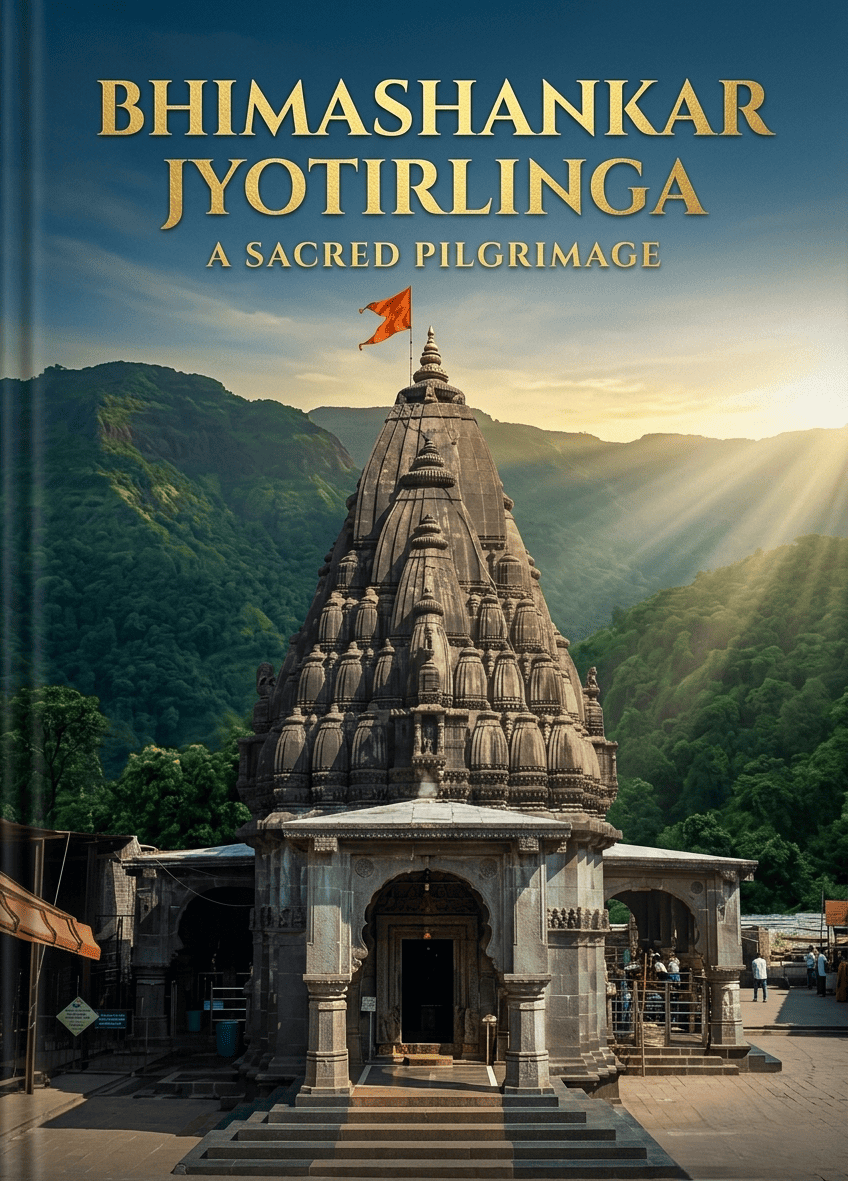
SHRI BHIMASHANKAR JYOTIRLINGA
CHAPTER SIX
Om Namah Shivaya
-------------------
INTRODUCTION
"Salutations to Lord Ganesha. Today, I narrate to you the wonderful story of Bhimashankar – the sixth among the twelve Jyotirlingas."
This is not merely a story – it is the tale of devotion, the tale of the slaying of a demon, and that divine play of Shiva's grace which teaches us – when the Bhima (ego, anger, desire) within us is destroyed by seeking refuge in Shiva, the inner light manifests.
-------------------
CHAPTER ONE
BHIMASHANKAR – IN THE LAP OF THE SAHYADRI
This is a very ancient tale... when the Sahyadri mountains were covered with dense forests.
Bhimashankar is located in the Pune district of Maharashtra. It is nestled in the lap of the Sahyadri mountains.
This place is extremely beautiful – lush green forests, tall mountains, and cool breezes. The origin of the Bhima river is also here.
"Bhimashankar is called the 'Shiva Dham of natural beauty'. Coming here brings immense peace to the mind."
--------------------------
CHAPTER TWO
THE DEMON BHIMA – SON OF KUMBHAKARNA
In ancient times, a terrible demon named Bhima lived in this region.
Who was Bhima? – He was the son of Kumbhakarna – who was himself Ravana's brother. That is, Bhima was Ravana's nephew.
Bhima was extremely powerful, cruel, and arrogant. He thought – "I am the sole king of this entire region. Everyone must worship me."
He spread his reign of terror throughout the Sahyadri region. He destroyed the hermitages of the sages, terrorized the devotees, and imprisoned the kings.
------------------------
CHAPTER THREE
KING SUDHANVAN IS IMPRISONED
At that time, the king of this region was Sudhanvan – who was extremely religious, just, and a devotee of Shiva.
The demon Bhima imprisoned King Sudhanvan.
The king was thrown into the dungeon.
The royal court was plundered.
The subjects were terrorized.
Even in the dungeon, King Sudhanvan kept remembering Lord Shiva. Tears flowed from his eyes – but "Om Namah Shivaya" never stopped flowing from his lips.
----------------------
CHAPTER FOUR
THE PRAYERS OF THE PEOPLE AND SHIVA'S APPEARANCE
When the people came to know that their king had been imprisoned, they gathered together. They thought – "Now only Shiva can protect us."
All the devotees and sages together called out to Lord Shiva.
"O Lord! Protect us. The demon Bhima has imprisoned our king. Our people are crying out for help."
And then... Lord Shiva appeared.
-----------------
CHAPTER FIVE
SHIVA'S FIERCE FORM – VOLCANIC RADIANCE
This time, Lord Shiva assumed a volcanic form – extremely radiant, blazing, and terrifying.
His radiance illuminated all directions. His roar made the earth tremble.
The demon Bhima saw this sight – but by now, it was too late.
Shiva slayed the demon Bhima with his trident.
"Immediately upon the demon's death, all the devotees raised cries of victory. King Sudhanvan was freed from the dungeon."
---------------------------------------
CHAPTER SIX
THE BHIMA RIVER – BORN FROM SHIVA'S SWEAT
There is another wonderful legend –
When Shiva slew the demon Bhima, he began to sweat.
That sweat flowed down to the earth and became a river.
That river was named – the Bhima river.
"The origin of the Bhima river is also here – near Bhimashankar. This river is a major river of Maharashtra."
--------------------------------
CHAPTER SEVEN
THE MYSTERY BEHIND THE NAME BHIMASHANKAR
The name "Bhimashankar" is composed of two words –
"Bhima" – the demon Bhima (who was slain)
"Shankar" – Lord Shiva
That is – Shiva who destroyed the demon Bhima = Bhimashankar.
"This is precisely why this Jyotirlinga came to be known as Bhimashankar."
--------------------
CHAPTER EIGHT
THE DIVINE HISTORY OF THE TEMPLE
Mythological Belief –
Bhimashankar is mentioned in the Shiva Purana, Skanda Purana, and Linga Purana.
It is believed that Lord Rama also worshipped here. It is said – Rama worshipped Bhimashankar and sought blessings for the war against Lanka.
Historical Background –
The temple was built in the 13th century.
The Peshwa rulers got this temple renovated.
In 1856, the temple was rebuilt.
It is protected by the Archaeological Survey of India (ASI).
Modern History –
Today, it is a major pilgrimage site in Maharashtra.
Millions of devotees visit here every year.
--------------------
CHAPTER NINE
THE TEMPLE'S ARCHITECTURE AND SPECIAL FEATURES
The architecture of the Bhimashankar temple is a blend of South Indian and Nagara styles.
Temple Structure –
Style – Blend of Nagara and Dravida styles
Sanctum Sanctorum – Houses the self-manifested Shivalinga
Spire – Massive and grand, 200 meters high
Courtyard – Very large, with space for thousands of devotees
Other Deities –
The temple complex also houses other temples – Lord Ganesha, Mother Parvati, Lord Vishnu, Nandi
Special Feature –
The Shivalinga is self-manifested – that is, it appeared on its own.
The origin of the Bhima river is here.
The sanctum sanctorum has a silver throne.
---------------------------------
CHAPTER TEN
BHIMASHANKAR WILDLIFE SANCTUARY
Bhimashankar is not just a pilgrimage site – it is also a wildlife sanctuary.
Features –
Rare birds and animals are found here.
It is home to leopards, bears, and deer.
It is a paradise for tourists and nature lovers.
"Here, you can have darshan of Shiva in the lap of nature – a wonderful experience!"
------------------------
CHAPTER ELEVEN
FESTIVALS AND SPECIAL RITUALS
Maha Shivaratri –
On Maha Shivaratri, special aarti and Rudrabhishek are performed here.
Thousands of devotees gather here.
Shravan Month –
During the month of Shravan, the Monday fasts hold special significance.
Devotees bring water from the Bhima river and perform abhishek on the Shivalinga.
Makar Sankranti –
On Makar Sankranti, special worship is performed here.
Taking a dip in the Bhima river holds special significance.
Bhimashankar Mela –
A large fair is held here every year.
Devotees come from far and wide.
--------------------
CHAPTER TWELVE
INTERESTING FACTS
First – Bhimashankar is one of the 12 Jyotirlingas located in Maharashtra.
Second – The origin of the Bhima river is here – which is a tributary of the Krishna river.
Third – The Shivalinga of Bhimashankar is self-manifested – that is, it appeared on its own.
Fourth – It is believed – having darshan here liberates one from fear.
Fifth – It is approximately 110 kilometers from Pune.
Sixth – It is protected by the Archaeological Survey of India (ASI).
----------------------
CHAPTER THIRTEEN
THE SPIRITUAL MESSAGE – THE ESSENCE OF THE STORY
This story carries a deep spiritual meaning –
1. The Bhima Within –
FESTIVALS AND SPECIAL RITUALS
Maha Shivaratri –
On Maha Shivaratri, special aarti and Rudrabhishek are performed here.
Thousands of devotees gather here.
Shravan Month –
During the month of Shravan, the Monday fasts hold special significance.
Devotees bring water from the Bhima river and perform abhishek on the Shivalinga.
Makar Sankranti –
On Makar Sankranti, special worship is performed here.
Taking a dip in the Bhima river holds special significance.
Bhimashankar Mela –
A large fair is held here every year.
Devotees come from far and wide.
--------------------
CHAPTER TWELVE
INTERESTING FACTS
First – Bhimashankar is one of the 12 Jyotirlingas located in Maharashtra.
Second – The origin of the Bhima river is here – which is a tributary of the Krishna river.
Third – The Shivalinga of Bhimashankar is self-manifested – that is, it appeared on its own.
Fourth – It is believed – having darshan here liberates one from fear.
Fifth – It is approximately 110 kilometers from Pune.
Sixth – It is protected by the Archaeological Survey of India (ASI).
----------------------
CHAPTER THIRTEEN
THE SPIRITUAL MESSAGE – THE ESSENCE OF THE STORY
This story carries a deep spiritual meaning –
1. The Bhima Within
— The End —